The 2025 Service AI Stats Every Leader Should Know

The State of Service AI
2025 was a defining year as AI projects shifted from pilots to production, exposing a clear divide between tools that deliver measurable impact and those that fall short. Investment surged as leaders prioritized accuracy, automation, and the ability to capture and scale expertise across their organizations.
High performers aren’t winning because they spend more, they’re winning because they chose solutions dedicated to service workflows, validated accuracy, and operational KPIs.
This data makes the direction unmistakable: AI is now shaping how service teams budget, design workflows, and measure performance. The organizations planning effectively for 2026 are the ones aligning to these realities, not last year’s assumptions.
Adoption Boom
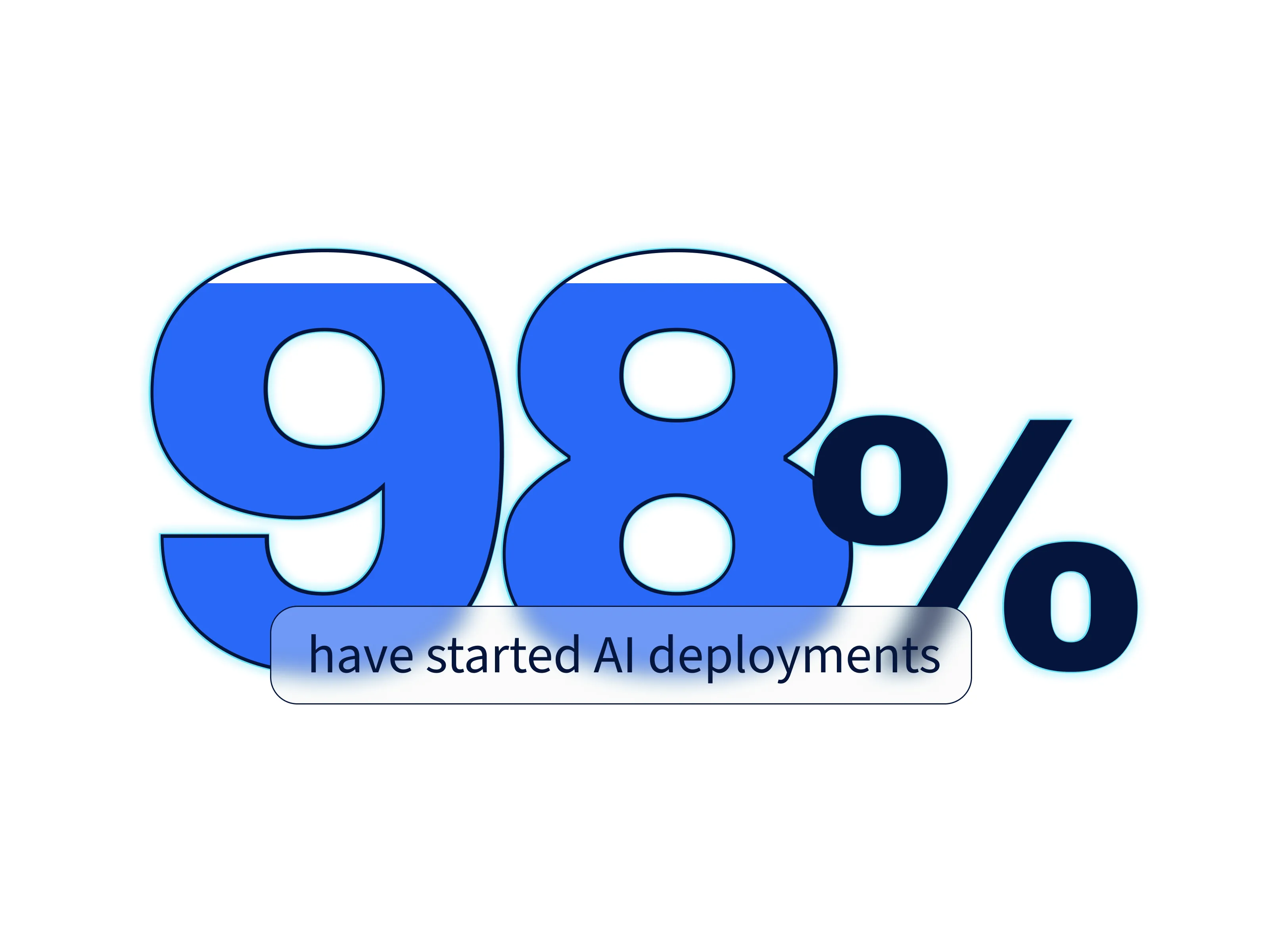
Service AI is no longer emerging tech; it’s becoming standard operating infrastructure across the industry, with 98 percent of service organizations having started their AI journey. Adoption is essentially universal at this point, making AI a competitive baseline rather than an experiment.
Among the organizations furthest along, three maturity stages stand out:
12% already have AI in full production, running it in daily service workflows and proving AI is now operational, not experimental.
34% are actively deploying AI across teams, putting real workflows and metrics in place and moving beyond pilots faster than any other segment.
30% are defining use cases, KPIs, and success criteria, building the accuracy, workflow, and ROI foundations required for scalable AI.
For a deeper breakdown of these patterns, see our Top Service AI Use Cases for 2025.
.avif)
Leadership Moment
AI investment surged this year as service leaders stepped into a more strategic role. What was once an IT-led exploration is now an operational leadership mandate, with the people closest to customers and frontline performance shaping requirements, priorities, and success criteria.
Service leaders are no longer just consumers of technology. They are helping define it.
86% of service leaders now influence or approve AI decisions, elevating service from stakeholder to strategic decision-maker.
(Source: Neuron7 Agentic AI Survey Findings, 2025)
Nearly 80% of AI decision-makers are director-level or above, reflecting a move toward operational ownership and away from isolated IT pilots.
(Source: Neuron7 Agentic AI Survey Findings, 2025)
75% of organizations increased AI budgets, signaling rising expectations for measurable impact and workflow integration.
(Source: Gartner, 2025 – “Most Valuable AI Use Cases for Customer Service & Support”)
85% will pilot or explore customer-facing GenAI in 2025, underscoring that AI decisions now shape the customer experience directly.
(Source: Gartner, 2024 – “85 Percent of Customer Service Leaders Will Explore or Pilot Conversational GenAI in 2025”)
For a deeper look at how service leaders are evaluating AI architectures and choosing service-grade solution partners, see our AI-as-a-Service Guide.
.avif)
The Outcome Divide
AI results diverged sharply in 2025. High performers pulled ahead by anchoring their programs to measurable KPIs—first-time fix rate, resolution speed, cost reduction, and productivity. They chose solutions that could meet service-grade accuracy and integrate directly into technician and agent workflows. Most stalled deployments shared a different problem altogether: the tools themselves weren’t built for service.
Generic AI couldn’t deliver the consistency, domain understanding, or actionable guidance required for complex issues. The result was predictable: slow adoption, eroded trust, and limited ROI—regardless of how committed the teams were.
The data is unambiguous: the solution you choose determines the outcomes you get.
95% of AI pilots fail under short-term P&L measurement, exposing the gap between early expectations and actual operational impact.
(Source: MIT Sloan / CSAIL)
Nearly 70% of stalled deployments cite accuracy or relevance issues, showing that generic AI models often fail to perform in complex service environments.
(Source: MIT Sloan / CSAIL)
72% of service leaders prioritize first-time fix rate and first-call resolution, signaling that top performers anchor AI outcomes in measurable service KPIs.
(Source: Neuron7 Agentic AI Survey Findings, 2025)
67% of organizations start with high-frequency, low-complexity issues, demonstrating the early-win strategy that separates scalable deployments from stalled ones.
(Source: Neuron7 Agentic AI Survey Findings, 2025)
.avif)
Planning Ahead
As AI moved into operational reality, leaders began planning around measurable outcomes, predictable ROI, and service-grade accuracy. The data from 2025 makes the direction clear: organizations are prioritizing faster resolutions, stronger knowledge access, and more effective self-service as they build their 2026 roadmaps.
Service leaders aren’t simply budgeting for AI. They’re designing operating models that require AI to perform with consistency, transparency, and domain expertise.
83% of service leaders prioritize faster resolution times heading into 2026, making operational efficiency the top planning imperative.
(Source: N7 Agentic AI Survey Findings, 2025)
71% plan to modernize information access, reflecting the need for centralized, accurate knowledge that supports frontline performance.
(Source: N7 Agentic AI Survey Findings, 2025)
AI operationalization ranked as a top three digital transformation challenge, reinforcing the need for clear workflows, measurable KPIs, and proven accuracy standards before scaling.
(Source: Service Council IdeaShare Report, 2025)
55% plan to expand technician and customer self-service, shifting simpler issues left and reducing overall service cost.
(Source: N7 Agentic AI Survey Findings, 2025)
.avif)
Why This Matters for 2026
2026 won’t be defined by experimentation. It will be defined by operational AI.
The organizations that will pull ahead are the ones planning around:
✔ Consistent accuracy
✔ Domain-specific workflows
✔ Measurable ROI
✔ Scalable knowledge access
✔ Frontline empowerment
These priorities now shape budgets, technology choices, job design, and the broader service blueprint.