
What is AI-guided troubleshooting?

AI-Guided Troubleshooting Isn't Smarter Search. It's a Resolution System.
Most AI deployments in service organizations begin by improving search. Leaders invest in systems that retrieve documentation faster, summarize manuals, or surface similar historical cases. These efforts address a legitimate challenge: locating relevant information in large knowledge repositories.
However, complex troubleshooting is not primarily a retrieval problem. It is a decisioning problem. The difference is subtle but operationally significant. Retrieval helps technicians find content. Decision systems govern the sequence of actions required to resolve an issue.
Understanding this distinction is essential to understanding AI-guided troubleshooting.
What is AI-guided troubleshooting?
AI-guided troubleshooting is a deterministic system that directs technicians through validated diagnostic pathways based on encoded expert logic.
Rather than presenting a list of potentially relevant documents, the system structures diagnostic steps into governed resolution paths. Each step reflects established expertise, compliance requirements, safety constraints, and parts validation rules. The logic determines the correct next action based on the current state of the case.
These structured diagnostic flows like Resolution Pathways, translates expert reasoning into repeatable resolution paths across technicians, regions, and product portfolios.
The defining characteristic of AI-guided troubleshooting is determinism. Identical case conditions produce identical guided sequences. The system does not suggest possibilities; it governs progression.
Why information retrieval breaks in complex service environments
Information retrieval performs well when issues are relatively simple and the correct answer resides within a discrete document. Under these conditions, accelerating access to information improves efficiency.
Enterprise service environments introduce a different level of complexity. Troubleshooting frequently involves interacting subsystems, conditional branching logic, regulatory constraints, regional configurations, parts dependencies, and defined escalation thresholds. Each diagnostic action changes the state of the asset and narrows the set of valid next steps.
In such environments, retrieving relevant information is insufficient. The technician must determine which action is appropriate given the evolving system state. AI search surfaces context. AI-guided troubleshooting manages that state and controls the decision sequence.
This shift from retrieval to governed execution represents a structural change in how service decisions are made.
Why the 80/20 pattern makes AI-guided troubleshooting scalable
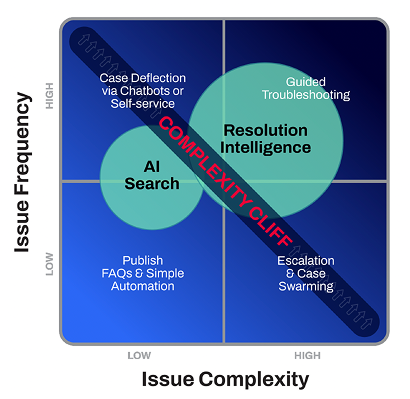
A common misconception is that AI must automate every possible scenario to deliver meaningful impact. In practice, most service organizations exhibit a concentrated distribution of issue types. A relatively small percentage of recurring problem categories drives the majority of case volume. Escalations and repeat visits tend to cluster around predictable failure modes.
By applying AI-guided troubleshooting to these high-frequency diagnostic paths, organizations can produce disproportionate results. Standardized execution improves first-time fix rates. Validated sequencing reduces unnecessary part replacement. Encoded escalation logic decreases deviation and variability.
This targeted governance allows organizations to achieve high levels of resolution accuracy without attempting to model every edge case within the service universe.
Why deterministic AI builds trust in service operations

Adoption in service environments depends on trust. Technicians and service leaders must understand and rely on the logic that governs decisions. Non-repeatable outputs, opaque reasoning, or inconsistent recommendations undermine confidence.
In regulated industries including medical devices, telecommunications, and industrial equipment, transparency and auditability are operational requirements.
AI-guided troubleshooting must therefore be deterministic. The same inputs must produce the same guided steps, and the reasoning behind each step must be traceable.
In modern service architectures, this deterministic governance is delivered through purpose-built AI agents that operate within structured resolution frameworks. These agents connect enterprise data, encoded expertise, and workflow execution.
Predictability drives adoption. Adoption enables measurable impact.
How AI-guided troubleshooting changes service economics
When troubleshooting transitions from an information retrieval model to a governed resolution system, the operating model shifts materially.
Decision trees become institutional assets rather than informal expertise. Junior technicians execute with greater consistency relative to experienced personnel. Escalation pathways are predefined and structured. Part replacement decisions are validated before action.
The economic implications follow directly. Reduced diagnostic variation leads to fewer repeat visits, lower parts waste, decreased escalation volume, and compressed resolution times. Service leaders gain visibility into diagnostic performance and logic effectiveness across the organization.
At this stage, AI-guided troubleshooting is no longer an enhancement to knowledge management. It becomes infrastructure for how service decisions are executed and scaled.
Move Beyond Search
AI does not fail in service because it lacks intelligence. It fails when it stops at retrieval.
AI-guided troubleshooting delivers sustained operational impact when it governs execution through validated, deterministic decision paths embedded directly into workflow. By shifting from information access to structured resolution systems, service organizations can scale expertise, improve consistency, and meaningfully change service economics.
Ready to explore how guided troubleshooting can transform your service operations?
Contact us for an AI Strategy Session to discuss how deterministic resolution logic can drive measurable outcomes in your organization.
Related articles



Frequently asked questions
What makes Neuron7 different from other AI tools for service?
Neuron7 differs from other AI tools for service by building a Service Expertise Graph from actual case history rather than searching documents and surfacing suggestions. Resolution guidance is deterministic and grounded in fixes your team has already performed. Neuron7 also predicts failures before they happen and improves with every case closed.
Does Neuron7 replace our existing CRM or ticketing system?
No. Neuron7 does not replace existing CRM or ticketing systems like Salesforce, ServiceNow, or SAP. Instead, it operates as a resolution intelligence layer on top of those systems, adding service expertise and resolution intelligence that those platforms do not natively provide.
How long does deployment take?
Neuron7 deployment typically takes weeks, not months. Most customers are running pilots within weeks of kickoff, starting with the highest-volume product lines and failure patterns before expanding across the installed base.
How does Neuron7 connect to our existing systems?
Neuron7 connects to existing systems through direct integrations with Salesforce, ServiceNow, SAP, Microsoft, and most major CRM and FSM platforms. Pre-built connectors require no custom development and no IT project. Technicians and agents continue working in the tools they already use, with Neuron7 surfacing guidance in their existing workflow.
What kind of service organizations use Neuron7?
Neuron7 is purpose-built for Fortune 1000 enterprises that manage complex technical equipment at scale. This includes medical devices, high-tech manufacturing, industrial systems, payment technology, and telecom organizations. Most customers have 1,000 or more service technicians operating across multiple regions or product lines.
Join the era of agentic service
.png)