
What happens when Kevin leaves?

The most expensive person in your service organization is not your most senior technician. It's the person who is about to leave.
When a field service tech retires after 20 years working on complex systems, they don't just take their tools. They take the answer to the question your newest hire will ask next week. They take the troubleshooting path that isn't written in any manual, the one that developed over a thousand service calls, the one that starts with a particular sound from a particular component and ends with a specific sequence no procedure document has ever captured.
That knowledge doesn't get transferred in an exit interview. It doesn't get uploaded to a knowledge base. It disappears. For TransLogic, a Swisslog Healthcare company that keeps computerized tube systems running in hospitals across the country, this was not a hypothetical risk. It was the reality they were facing.
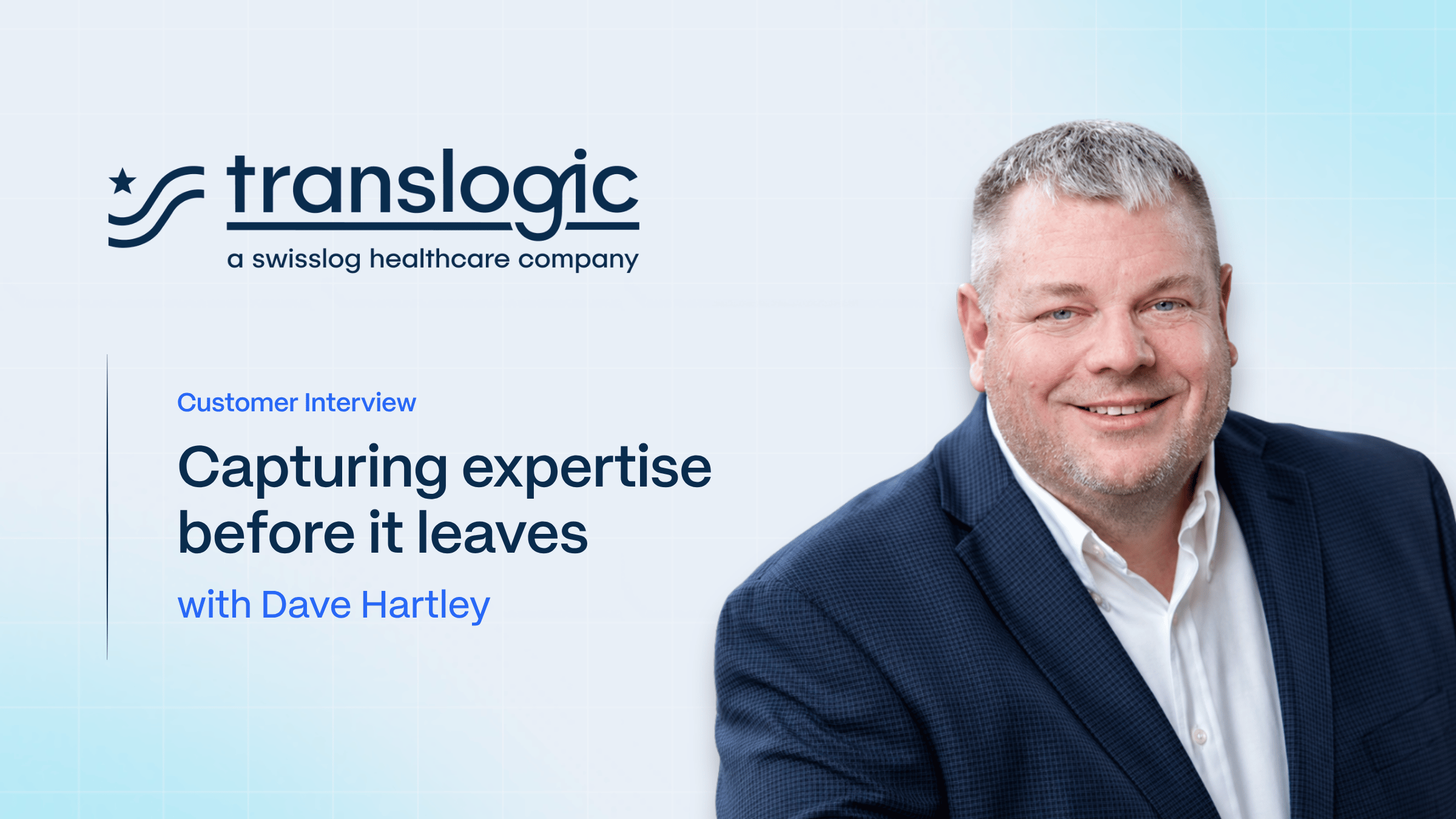
We sat down with Dave Hartley, VP of Customer Care at TransLogic, to talk about what that problem actually looks like from the inside, what he did about it, and why the answer surprised him.
A conversation with Dave Hartley, VP Customer Care at TransLogic
"The problem is, troubleshooting is often a matter of 'call Kevin.'"
When you describe the knowledge problem you were facing, what does that actually look like day-to-day?
Dave Hartley: We're having a lot of techs with 30 or 40 years of experience retiring, and we're losing a lot of knowledge as a result. A lot of the institutional knowledge just isn't written down.
The problem is, troubleshooting is often a matter of "call Kevin; he's dealt with that before." But what happens when Kevin isn't here anymore?
How does that affect your newer technicians?
Dave Hartley: The industry is at an inflection point. Equipment is growing more complex, with failures that span hardware, software, and network components simultaneously. At the same time, the average seniority of service teams is decreasing as retirements accelerate and new hires arrive without exposure to these failure modes. More complex problems, fewer people who know how to solve them.
What was the resolution process before Neuron7?
Dave Hartley: Before Neuron7, a technician could spend three hours troubleshooting a single issue, searching through manuals, calling colleagues, and trying different approaches. The answer usually existed somewhere: in someone's head, in an old case note, in a procedure modified based on field experience but never formally documented. The time cost was real. The knowledge was there, just not accessible.
"What the engineer puts in a book and what the technician does in the field don't always line up."
One of the challenges we hear from service organizations is that documented procedures and field reality are two different things. How did that show up for you?
Dave Hartley: What the engineer puts in a book and what the technician does in the field don't always line up. Field experience modifies procedures. A technician learns over time that step four needs to happen differently on a particular product generation, or that a certain error code means something that isn't in the official documentation.
That real-world refinement, that's the knowledge that walks out the door when people retire.
What made that problem difficult to solve with your existing tools?
Dave Hartley: Existing search tools return a list of results without telling a technician which one applies to their specific situation. A new technician searching for a resolution path might get fifteen documents with no guidance on where to start. Getting lucky or spending three hours working through them systematically were the only options, and neither is acceptable when a hospital is waiting for their pneumatic tube system to come back online.
The result: 3 hours to 3 seconds. 96% accuracy.
What changed after deploying Neuron7?
Dave Hartley: "The beautiful thing about Neuron7 is that you can take resolutions from case history and instead of 3 hours of troubleshooting, the technician has the answer in 3 seconds."
That is not a figure of speech. An answer that previously required searching through documents, calling colleagues, and working through a non-deterministic process is now delivered in seconds, with 96% accuracy, inside the platform the technician already uses. Senior Tech Support Specialist, Mike Lilja knows this firsthand, having seen how Salesforce integration makes that speed a daily reality for his team.
What made the accuracy number significant to you specifically?
Dave Hartley: For a team maintaining medical equipment inside hospitals, accuracy is the only metric that matters. Downtime has patient care implications. A wrong resolution path does not save time, it adds risk. Generic AI tools present results with equal confidence regardless of whether the answer fits the specific product, version, or failure pattern. In a complex service environment, that is not acceptable. Neuron7 is purpose-built for that specificity, learning from TransLogic's own service data, technician feedback, and case history.
You mentioned 2,000 warranty hours saved. How does that connect to the knowledge capture piece?
Dave Hartley: Warranty claims happen when technicians cannot resolve issues efficiently, putting in parts that were not needed or missing the root cause the first time. Every resolved case in Neuron7 becomes part of the resolution intelligence for future calls, so the savings compound. TransLogic captured $90,000 in warranty cost savings in the first deployment period, a number that grows as the system learns.
"It doesn't matter if you've been here 20 years, 10 years, or two years."
You mentioned the system was originally expected to be most useful for new technicians. What actually happened?
Dave Hartley: Initially, I thought it would be mainly for new technicians to quickly learn the basics, and then they'd outgrow it. But it's become much more useful, even for senior technicians.
The reason is this: no matter how experienced you are, the equipment is complex and the failure modes are varied. Having a system that can surface the optimal resolution path faster than you could work through it manually saves time for everyone. It's not about compensating for inexperience, it's about giving everyone access to the organization's collective knowledge, all at once.
"No matter how experienced the technician is, you can come up with the answer in N7 so much faster than it would be to call tech support. It doesn't matter if you've been here 20 years, 10 years, or two years, it can be a useful tool."
What does the onboarding experience look like now for a new technician?
Dave Hartley: New technicians can now reach operational speed significantly faster. The gap between a new hire and an experienced technician used to be measured in years. That gap still exists in terms of experience, but the resolution quality gap is much smaller from day one, because the new technician has access to the same knowledge base as the senior technician.
What the engineer puts in a book becomes actionable field guidance. What the experienced technician learns in 20 years becomes accessible to someone in their first 90 days. That value only grows as more cases get resolved and more knowledge gets captured.
What the TransLogic story means for your service organization
The problem TransLogic solved is not unique to healthcare or medical device service. It is the problem facing every service organization managing complex equipment, multi-product portfolios, or an aging expert workforce.
The pattern is consistent: knowledge exists, but it is trapped, in people's heads, in documents no one can find, in procedures that don't reflect field reality. When complex systems fail and the person who knows the answer isn't available, the cost shows up in resolution time, warranty claims, repeat dispatches, and CSAT scores.
What the TransLogic case demonstrates is not just that AI can help, but that the kind of AI matters. The difference between a system that retrieves documents and one that delivers the right answer for the right product in the right situation is measurable. It shows up in a 96% accuracy rate. It shows up in resolution time going from hours to seconds. It shows up in 960 warranty hours not spent on failures that should have been resolved correctly the first time.
If you have a "Kevin" problem, a concentration of knowledge in specific people that you cannot afford to lose, the question is not whether to solve it. It's whether you solve it before or after Kevin leaves.
Key results: TransLogic x Neuron7
Here's what the numbers look like after deploying Neuron7 at Translogic:
- 96% resolution accuracy
- Resolution time reduced from 3 hours to 3 seconds
- Complex issue resolution time reduced from 3 months to 1 week
- 2,000 warranty hours saved
- $90,000+ in warranty cost savings (and growing)
- 1 minute saved per 5-minute call
- Deployed on Salesforce Field Service
About TransLogic
TransLogic is a Swisslog Healthcare company that designs, manufactures, and services computerized pneumatic tube systems for hospitals and healthcare facilities across North America. Their systems transport medications, lab specimens, and critical materials throughout clinical environments where uptime directly affects patient care. Read the full TransLogic customer case study.
About Neuron7
Neuron7's Service Resolution Intelligence brings together knowledge from thousands of people, data sources, and service interactions to resolve issues faster in complex service environments. Purpose-built for organizations managing complex, multi-product equipment, Neuron7 delivers 90%+ resolution accuracy, guided diagnostics within existing CRM platforms, and measurable ROI within 90 days. Deployed by global leaders in medical devices, industrial equipment, high tech, and telecom equipment, including TransLogic, Ciena, NCR Atleos, and TK Elevator.
Related articles



Frequently asked questions
What makes Neuron7 different from other AI tools for service?
Neuron7 differs from other AI tools for service by building a Service Expertise Graph from actual case history rather than searching documents and surfacing suggestions. Resolution guidance is deterministic and grounded in fixes your team has already performed. Neuron7 also predicts failures before they happen and improves with every case closed.
Does Neuron7 replace our existing CRM or ticketing system?
No. Neuron7 does not replace existing CRM or ticketing systems like Salesforce, ServiceNow, or SAP. Instead, it operates as a resolution intelligence layer on top of those systems, adding service expertise and resolution intelligence that those platforms do not natively provide.
How long does deployment take?
Neuron7 deployment typically takes weeks, not months. Most customers are running pilots within weeks of kickoff, starting with the highest-volume product lines and failure patterns before expanding across the installed base.
How does Neuron7 connect to our existing systems?
Neuron7 connects to existing systems through direct integrations with Salesforce, ServiceNow, SAP, Microsoft, and most major CRM and FSM platforms. Pre-built connectors require no custom development and no IT project. Technicians and agents continue working in the tools they already use, with Neuron7 surfacing guidance in their existing workflow.
What kind of service organizations use Neuron7?
Neuron7 is purpose-built for Fortune 1000 enterprises that manage complex technical equipment at scale. This includes medical devices, high-tech manufacturing, industrial systems, payment technology, and telecom organizations. Most customers have 1,000 or more service technicians operating across multiple regions or product lines.
Join the era of agentic service
.png)