
Highlights from Field Service Palm Springs: From Strategy to AI Success

Field Service Palm Springs 2025 brought together the top minds in service innovation. With more than 800 executives and over 100 expert speakers, FSPS continues to be the premier event for shaping the future of field service.
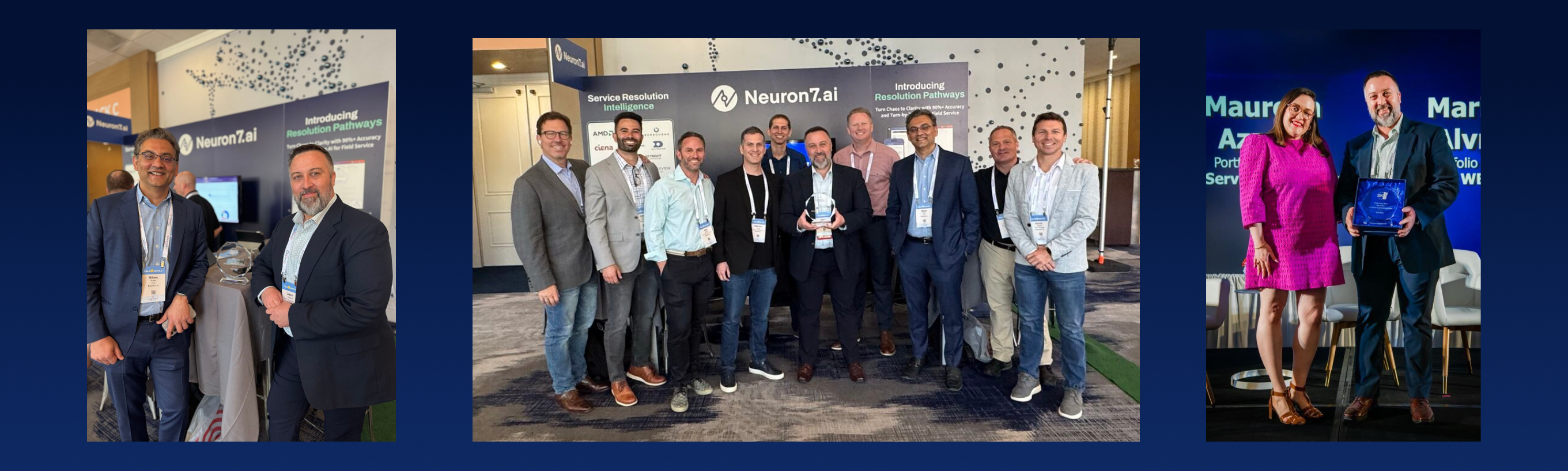
Neuron7’s presence stood out this year, with features in the first-ever AI Advisory Labs sessions and a packed workshop session with Neuron7 customers.
The event also recognized NCR Atleos with the Best AI Use Case & Implementation Award for their global service transformation powered by Neuron7’s domain-specific AI.
Key Takeaways from Service Leaders at FSPS
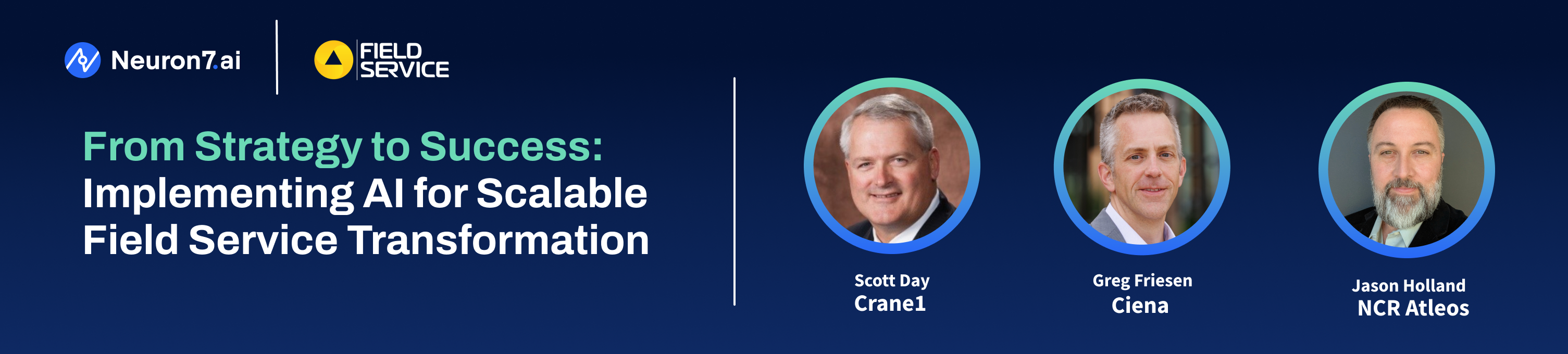
During the Neuron7 customer session at FSPS, service leaders from NCR Atleos, Ciena, and Crane1 shared actionable insights and AI best practices from their organizations. Highlights from the discussion:
Building a Compelling Business Case
Scott Day, COO at Crane1, shared that gaining executive and financial support for AI initiatives requires clearly aligning early on the metrics that matter most to the business. Without strong alignment around targets for improvement, building a convincing business case becomes far more difficult.
“One of the things that we looked at was aligning on metrics real early—what are the targets to improve and KPIs that our finance people like to hear about? If you don’t get those metrics aligned early on in the business case, you'll have hard time getting people on the board to commit to that investment.”
Scott Day, COO, Crane1
Defining the Right KPIs
Greg Friesen from Ciena emphasized that AI initiatives must be grounded in KPIs that truly move the needle for the business—especially those tied to customer experience. He described how improving resolution time has had a direct, measurable impact on customer satisfaction.
Since deploying AI in tech support, Ciena has seen:
- 44% improvement in case resolution time
- 14-point increase in customer satisfaction scores
- 50% case deflection, with AI suggesting resolutions before cases are submitted
These results validated their approach and created internal momentum to scale AI across additional product lines and use cases.
“Certainly at Ciena, customer experience is our North Star and what we see from surveys is that the number one predictor of CSAT is time to resolution...since we've implemented AI in this specific use case, we've had a 44% improvement in our case resolution time. Over that period we've also had about a 14-point improvement in our CSAT scores.”
Greg Friesen, VP & General Manager, Global Services and Support, Ciena
Driving AI Adoption Through Engagement
Jason Holland from NCR Atleos outlined how their team moved beyond basic usage tracking to build meaningful adoption — tying technician engagement to both quality metrics and continuous feedback loops that improved the AI over time:
“We built strong analytics in Power BI to track usage, including how long technicians engaged with the tool. Adoption wasn't just about usage — we tied it to quality metrics and incentivized technicians to contribute feedback, helping the AI improve continuously.”
Jason Holland, Executive Director, Global Field Operations, NCR Atleos
Real-World Results: NCR Atleos’ AI Transformation
NCR Atleos’ success was a highlight of FSPS 2025, earning them the Best AI Use Case & Implementation Award. Their transformation included:
- Unifying knowledge from 17 platforms.
- Achieving 92% AI answer accuracy.
- Reducing service revisits by 13%.
- Saving 400,000 minutes of technician time.
- Realizing a 4X ROI in just 2.5 months.
Their journey shows how aligning the right metrics, engaging field teams early, and focusing on real business outcomes accelerates AI success.
Ready to Build Your AI Strategy?
From NCR Atleos to Ciena and Crane1, industry leaders are tappingNeuron7’s domain-specific AI to deliver faster resolutions, higher customer satisfaction, and scalable knowledge capture across service operations.
Check out the AI for Service Buyers Guide to explore how leading service organizations are scaling AI successfully with Neuron7 and visit the AI Strategy Resource Center.
Related articles



Frequently asked questions
What makes Neuron7 different from other AI tools for service?
Neuron7 differs from other AI tools for service by building a Service Expertise Graph from actual case history rather than searching documents and surfacing suggestions. Resolution guidance is deterministic and grounded in fixes your team has already performed. Neuron7 also predicts failures before they happen and improves with every case closed.
Does Neuron7 replace our existing CRM or ticketing system?
No. Neuron7 does not replace existing CRM or ticketing systems like Salesforce, ServiceNow, or SAP. Instead, it operates as a resolution intelligence layer on top of those systems, adding service expertise and resolution intelligence that those platforms do not natively provide.
How long does deployment take?
Neuron7 deployment typically takes weeks, not months. Most customers are running pilots within weeks of kickoff, starting with the highest-volume product lines and failure patterns before expanding across the installed base.
How does Neuron7 connect to our existing systems?
Neuron7 connects to existing systems through direct integrations with Salesforce, ServiceNow, SAP, Microsoft, and most major CRM and FSM platforms. Pre-built connectors require no custom development and no IT project. Technicians and agents continue working in the tools they already use, with Neuron7 surfacing guidance in their existing workflow.
What kind of service organizations use Neuron7?
Neuron7 is purpose-built for Fortune 1000 enterprises that manage complex technical equipment at scale. This includes medical devices, high-tech manufacturing, industrial systems, payment technology, and telecom organizations. Most customers have 1,000 or more service technicians operating across multiple regions or product lines.
Join the era of agentic service
.png)