
Field Service Medical 2026 Recap: The AI Shift Reshaping Service

AI is not a tool. It's an operating model shift.
At Field Service Medical, the conversation surrounding AI reflected a notable evolution. Discussions no longer centered on whether AI functions effectively in isolated pilots. Instead, service leaders focused on how to embed AI structurally within operational design.
The prevailing theme was clear: AI is increasingly being treated not as an auxiliary tool layered onto existing systems, but as a foundational component of how service organizations are architected and governed.
In earlier cycles of adoption, much of the dialogue revolved around experimentation and proof-of-concept initiatives. This year, however, leaders emphasized governance frameworks, disciplined rollout strategies, workforce enablement, and the organizational conditions required to scale responsibly. The emphasis has shifted from technological feasibility to operational durability.
Securing AI success takes guts
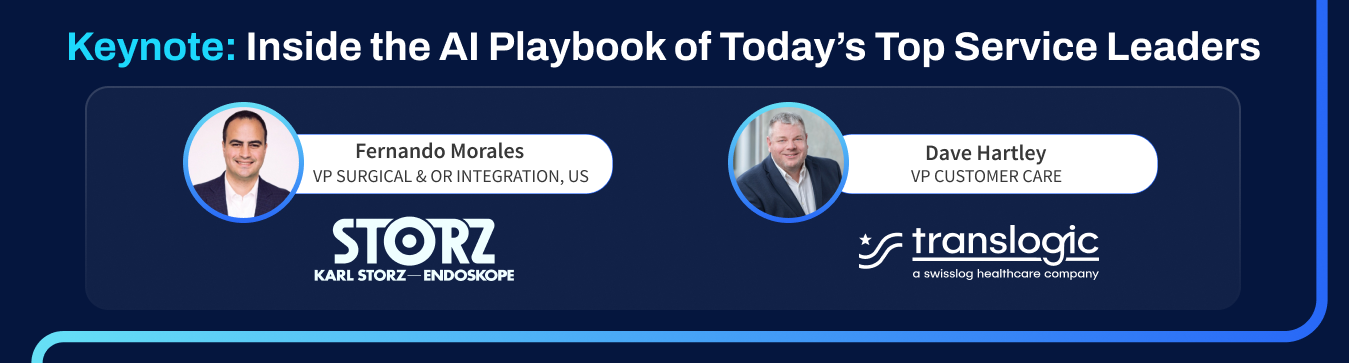
Dave Hartley, VP of Customer Care at TransLogic, offered a candid reflection on what sustained implementation truly requires. Having operated AI-enabled service environments for more than three years, he represents one of the earlier adopters within the medical device sector. His initial attempt, by his own account, was unsuccessful—not because of technical limitations, but because of cultural misalignment.
"I failed miserably the first time. I went with the stick instead of the carrot and it simply failed ."
His early rollout relied on enforcement rather than engagement. The lesson was immediate and consequential: adoption cannot be mandated. Technicians must perceive the system as a resource designed to support their expertise rather than surveil or replace it. When the technology was reframed as an enablement mechanism, measurable outcomes followed.
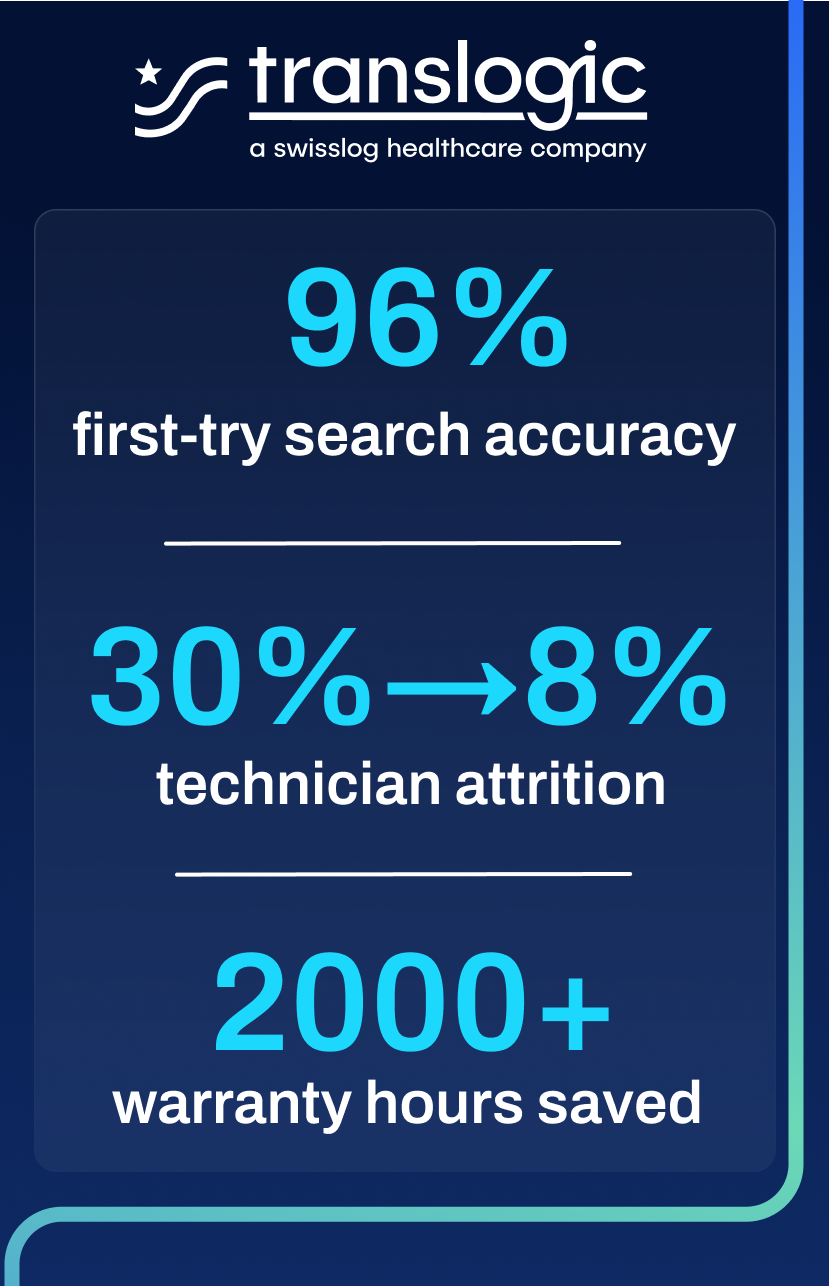
"Before we first started working with this tool, our attrition rate was 30% in the field. Last year we finished at 8%."
Perhaps most revealing was the impact on workforce stability. Prior to implementation, field attrition hovered near 30 percent. Within several years of sustained AI integration, attrition declined to 8 percent. Such a reduction reflects more than operational efficiency; it signals a workforce that feels better equipped, more confident in decision-making, and more supported in executing complex service tasks.
It's all about the field techs
Fernando Morales, VP Surgical & OR Integration, US at Karl Storz, described a similar philosophy in his deployment approach. His priority was not merely technological integration, but psychological ownership. From the outset, the initiative was positioned as an investment in field service personnel rather than as a centralized corporate mandate.
"This is absolutely for you. It's a major investment for field service first and they believe it is their tool, made specifically for them."
That framing proved decisive. When technicians regarded the system as “their tool,” they contributed to its refinement, maintained its integrity, and advocated for broader usage. Adoption, therefore, was not measured by the completion of a pilot program. It was assessed by ubiquity of use and by whether the technology had become inseparable from daily workflow.
"For me, one of the measures is, is it being used? Is the use ubiquitous and are people finding value in that?"
Operational infrastructure is defined by reliance. When intelligence is consistently embedded within task execution and consulted as part of standard procedure, it ceases to be experimental. It becomes structural.

Service intelligence extends beyond troubleshooting
Another theme that emerged from Field Service Medical concerned the proliferation of device-generated data. In highly regulated and equipment-intensive industries such as medical devices, telemetry and IoT signals are no longer scarce. The strategic challenge is not data acquisition but interpretability.
Leaders emphasized the importance of integrating equipment telemetry with technician knowledge to construct a comprehensive diagnostic context. In doing so, service organizations move beyond reactive troubleshooting and toward anticipatory intervention. Intelligence begins to shape not only internal operations but also customer-facing value propositions.
As predictive insights mature, service capabilities increasingly influence how organizations differentiate themselves in the market. Intelligence is becoming embedded not merely in execution, but in what service organizations ultimately sell: reliability, foresight, and reduced operational risk.
Connect the service lifecycle with AI as catalyst
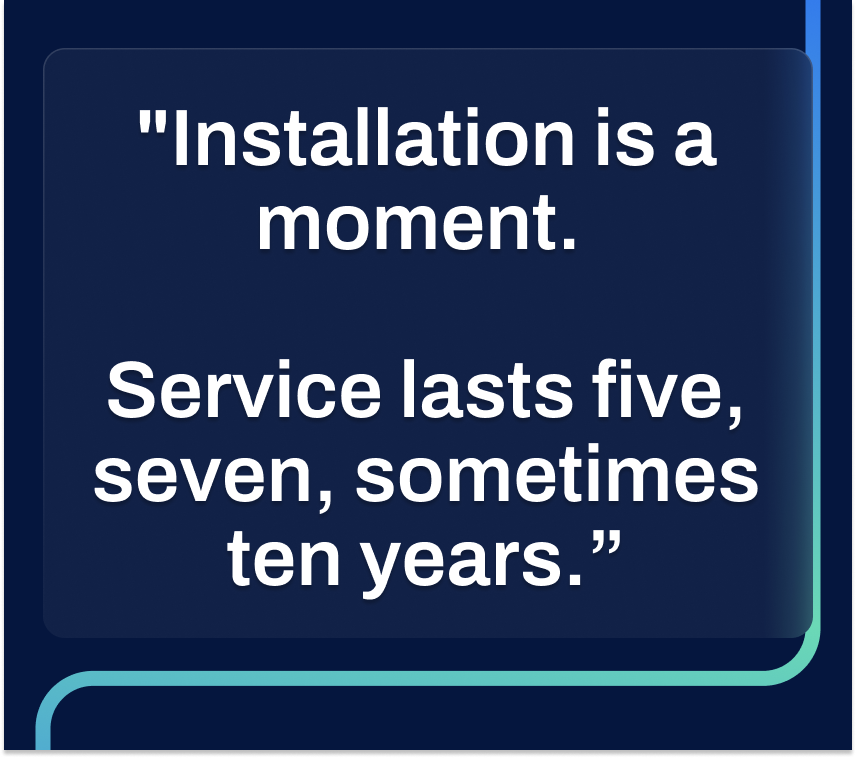
In an earlier keynote session, Fernando Morales (Karl Storz) highlighted the strategic importance of lifecycle continuity. Installation, while critical, represents a discrete event. Service, by contrast, extends across five to ten years and encompasses numerous transition points between teams, roles, and ownership structures.
"Installation is a moment. Service lasts five, seven, sometimes ten years. The race is not won by the fastest runners. It's won in the handoff."
Operational breakdowns often occur not because of insufficient expertise, but because knowledge becomes fragmented at these transition points. When intelligence is embedded directly into workflow, continuity is preserved. Decision logic, historical context, and institutional expertise remain accessible even as personnel or responsibilities change.
This perspective reinforces the broader shift observed throughout the conference: AI is no longer being appended to service operations as an enhancement layer. It is being integrated into the operational fabric itself.
Make the move from pilot to operations
The overarching takeaway is that leaders advancing from pilot programs to operational scale are not waiting for ideal conditions. They are formalizing governance structures, rigorously measuring adoption, and redesigning workforce processes with intelligence embedded as a constant input rather than an occasional assist. In doing so, they are reframing AI from a discrete initiative to an operating principle.
Within complex medical device service environments, sustained advantage will accrue to organizations that treat intelligence not as a feature layered onto existing systems, but as foundational infrastructure shaping how service is executed.
For service leaders evaluating how to operationalize intelligence across service, explore how Neuron7 supports medical device organizations with AI-guided resolution systems built for complex equipment and regulated environments.
Related articles



Frequently asked questions
What makes Neuron7 different from other AI tools for service?
Neuron7 differs from other AI tools for service by building a Service Expertise Graph from actual case history rather than searching documents and surfacing suggestions. Resolution guidance is deterministic and grounded in fixes your team has already performed. Neuron7 also predicts failures before they happen and improves with every case closed.
Does Neuron7 replace our existing CRM or ticketing system?
No. Neuron7 does not replace existing CRM or ticketing systems like Salesforce, ServiceNow, or SAP. Instead, it operates as a resolution intelligence layer on top of those systems, adding service expertise and resolution intelligence that those platforms do not natively provide.
How long does deployment take?
Neuron7 deployment typically takes weeks, not months. Most customers are running pilots within weeks of kickoff, starting with the highest-volume product lines and failure patterns before expanding across the installed base.
How does Neuron7 connect to our existing systems?
Neuron7 connects to existing systems through direct integrations with Salesforce, ServiceNow, SAP, Microsoft, and most major CRM and FSM platforms. Pre-built connectors require no custom development and no IT project. Technicians and agents continue working in the tools they already use, with Neuron7 surfacing guidance in their existing workflow.
What kind of service organizations use Neuron7?
Neuron7 is purpose-built for Fortune 1000 enterprises that manage complex technical equipment at scale. This includes medical devices, high-tech manufacturing, industrial systems, payment technology, and telecom organizations. Most customers have 1,000 or more service technicians operating across multiple regions or product lines.
Join the era of agentic service
.png)