
The decision layer aftermarket service teams are missing


Most industrial OEMs already have AI somewhere in their service organization. What they don't have is a decision layer: the part of the system that turns fragmented service data into one accurate answer for one fault, on one machine, for the technician standing in front of it. Search tools retrieve documents and copilots draft summaries, but neither one decides. That gap is why so many aftermarket service AI pilots stall before they reach the field.
Your SLA is only as fast as the one person who knows the fix
When a plant hits a problem its maintenance team can't resolve, the call comes to your team. Your aftermarket service organization is expected to diagnose the issue, get the right expertise involved, and get the equipment back in operation, often against an SLA with production already at risk.
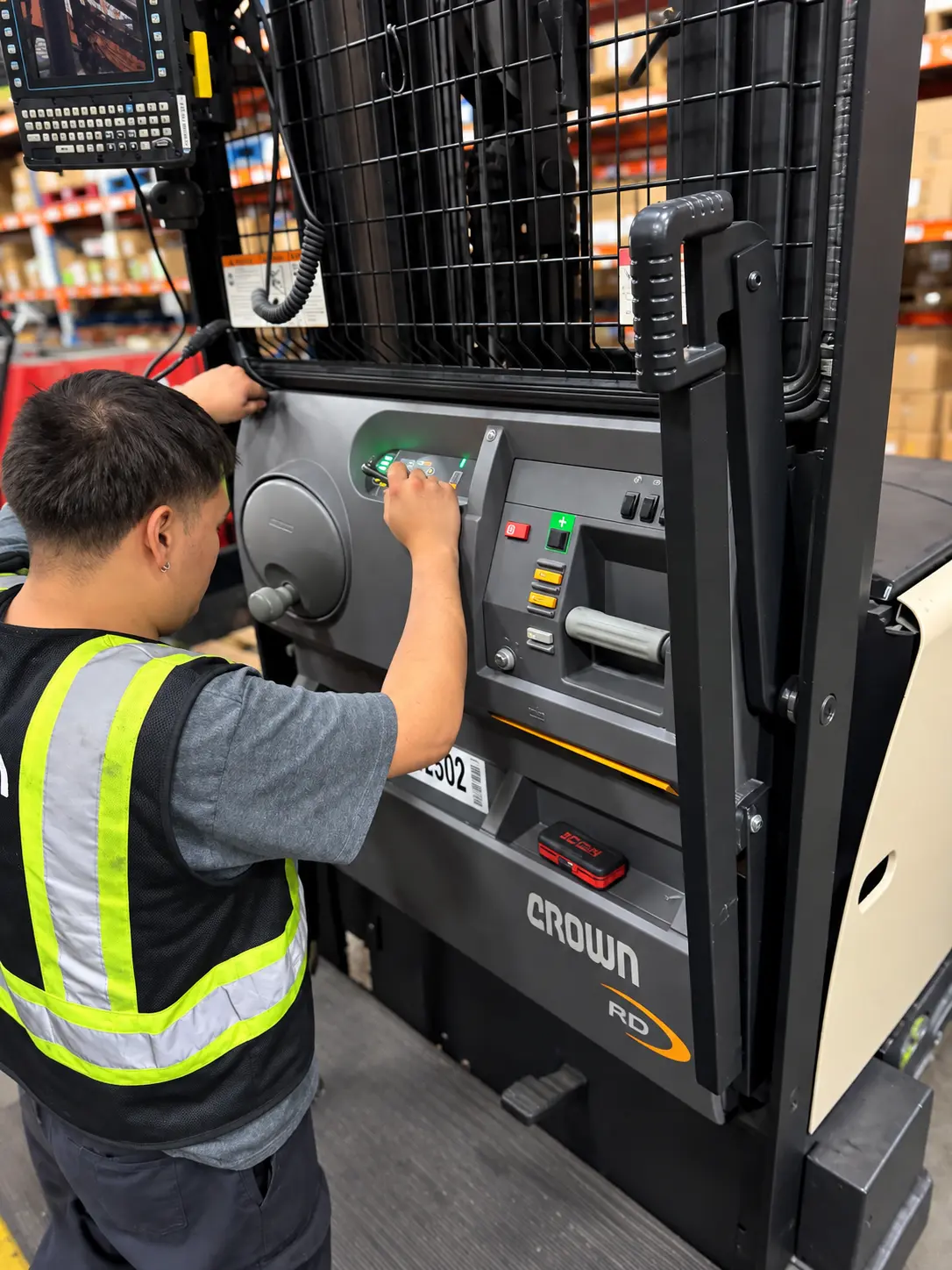
Getting a technician on site is the easy part. The harder problem is reaching the right resolution quickly when the answer depends on equipment history, configuration, service records, and the experience of a handful of experts who know the machine inside and out.
Every minute spent searching for that expertise extends downtime and puts pressure on the team to deliver against the service commitment. For the OEM, resolution speed is a core part of what the customer is paying for.
The real cost of missing a decision layer
A technician arrives at a complex piece of equipment without a system to guide the diagnosis, so the fix is a guess. When the guess is wrong, the visit doesn't end, it just gets rescheduled, carrying its own labor, parts, and travel cost on top of the first one. Multiply that across a service organization and revisits stop being an exception, they become a large share of total service volume, which is why first-call resolution rates for most teams top out around 65 to 70 percent.
On complex industrial assets, every extra hour spent guessing runs against a resolution window with a contractual penalty attached, sometimes tens of thousands of dollars per hour on network equipment or production-critical machinery.
Why what you've already tried doesn't fix it
Most aftermarket service leaders have already put a copilot on top of their service data, and it hits a wall fast. It can summarize a case or draft a reply, but it has no idea which fault code on a given machine correlates with which fix, because that knowledge lives in years of resolved tickets, not in the model's training data. Most service organizations won't let a public model near that data anyway, so the copilot ends up reasoning from ticket status in the CRM, not diagnosis.
The CRM has the same blind spot. It tracks a case through a workflow, not which of six possible failure modes actually matches what a technician is seeing. A knowledge base hits a similar wall: articles go stale the moment a technician finds a better fix in the field and never writes it down. They're different tools solving different problems, but none of them reason across fault codes, service history, and outcomes at the same time.
That last row gets harder to fix as equipment gets more complex. A single product family might carry 50 to 200 distinct failure modes, each needing its own diagnostic sequence, and a probabilistic guess from a general-purpose AI isn't built for that kind of precision. Once a copilot's accuracy drops to 55 to 60 percent, technicians stop trusting it within weeks and go back to calling the senior tech who already knows the answer.
MIT's 2025 State of AI in Business research found that only about 5% of enterprise generative AI pilots produce measurable financial return. Service data is a big reason why: most of it is unstructured and scattered across hundreds of sources, never built for a model to reason from.
Leaders keep trying anyway, just not as one initiative. Most end up running a dozen or more separate projects, one per region, product line, or team, each with its own model and its own owner. Gartner expects more than 40% of agentic AI projects to be canceled by 2027, most often over unclear business value or rising cost.
None of them add up to a plan. What's missing is the layer that knows which fix applies to which fault on which machine, and gets more accurate every time a technician uses it.
The decision layer, defined
A service decision layer is an intelligence system that sits between raw service data and the technician who needs to fix something. It connects case histories, device logs, manuals, technician notes, and live machine states, then translates all of it into a ranked list of likely root causes and next-best-actions, complete with tool and parts requirements. Workflow tools route tickets and track SLAs. A decision layer diagnoses: it evaluates the likelihood of each root cause based on real-time anomalies and equipment age, then guides the technician through the resolution pathway that already worked.
Neuron7 calls this the Service Decision Graph. It's a single intelligence layer that gets sharper with each fix. The graph encodes relationships between failure modes, components, and resolutions across your installed base, so technicians start with what already worked. When a compressor fails with a specific error code on a three-year-old unit in a high-temperature region, the graph knows which fixes resolved that pattern before, which parts were replaced, and which diagnostic steps confirmed the root cause.
What separates a decision layer from generic service AI
Three architectural differences explain why purpose-built decision layers outperform horizontal AI tools in complex service environments.
Deterministic reasoning over probabilistic guesses
A decision layer selects from proven resolution pathways grounded in verified examples. Each recommendation cites the evidence behind it, such as "47 similar cases with 94 percent resolution success." Generic LLMs generate novel answers that may hallucinate or contradict known-good procedures. A technician standing in front of a stalled machine with production down doesn't have room for a hallucinated answer. Guess wrong here and the line stays down.
Closed-loop learning over manual retraining
The system improves automatically from resolved cases. Approaches that require engineers to edit knowledge bases or retrain models manually fall behind as products evolve and new failure modes emerge. Neuron7's Service Decision Platform captures technician decisions and outcomes continuously, so the graph stays current without dedicated data science effort. Every closed case makes the next recommendation sharper.
A proven architecture over starting from scratch
A single-customer model has to learn your failure modes, your fault codes, and your resolution patterns from zero, which is why so many pilots need six to twelve months before they show any value, if they get there at all. Neuron7's Service Decision Graph is built on an architecture already refined across dozens of industrial and equipment deployments, so a new customer's graph starts from a mature reasoning framework instead of a blank model. Customers inherit an architecture built over years, not version one. Their own case history, fault codes, and technician decisions train their own graph from there, and it gets sharper every time a technician uses it.
Results from two large service fleets
TK Elevator runs one of the largest connected service fleets in the industry, with 25,000 technicians supporting 160,000 IoT-connected elevators across 100 countries. After deploying Neuron7's mobile-first guided diagnostics, the company cut inbound calls by 28% and reduced call handle time by three minutes per case, giving technicians answers in the format they already use instead of a separate tool they had to go find.
A comparable pattern shows up outside industrial equipment too. NCR Atleos services 60,000 ATMs across 48 countries and reached 92% resolution accuracy after deploying Neuron7, with a 4x return on investment, payback in 2.5 months, and a 13% drop in technician revisits. The install base is different, but the underlying problem is the same: a large, complex, distributed fleet that neither a search tool nor a CRM-bound agent could keep up with.

Where you land depends on three questions
Before adding another pilot to the pile, run your service organization through this checklist. If you answer yes to more than one, purpose-built AI beats both building your own and buying a generic tool.
- Does your service data span hundreds of sources and thousands of product configurations, most of it unstructured?
- Have you already tried a copilot or generic AI tool and hit a wall on accuracy or adoption?
- Are your AI pilots multiplying by region or product line without a shared decision layer connecting them?
Aftermarket service teams shouldn't have to accept a 50% accuracy ceiling.
Neuron7 will be at IMTS 2026 in Chicago, September 14-19 to showcase what our service decision intelligence platform looks like for manufacturing service teams. Stop by Booth #237614, or schedule time with our team in advance.
Related articles




Frequently asked questions
What makes Neuron7 different from other AI tools for service?
Neuron7 differs from other AI tools for service by building a Service Expertise Graph from actual case history rather than searching documents and surfacing suggestions. Resolution guidance is deterministic and grounded in fixes your team has already performed. Neuron7 also predicts failures before they happen and improves with every case closed.
Does Neuron7 replace our existing CRM or ticketing system?
No. Neuron7 does not replace existing CRM or ticketing systems like Salesforce, ServiceNow, or SAP. Instead, it operates as a resolution intelligence layer on top of those systems, adding service expertise and resolution intelligence that those platforms do not natively provide.
How long does deployment take?
Neuron7 deployment typically takes weeks, not months. Most customers are running pilots within weeks of kickoff, starting with the highest-volume product lines and failure patterns before expanding across the installed base.
How does Neuron7 connect to our existing systems?
Neuron7 connects to existing systems through direct integrations with Salesforce, ServiceNow, SAP, Microsoft, and most major CRM and FSM platforms. Pre-built connectors require no custom development and no IT project. Technicians and agents continue working in the tools they already use, with Neuron7 surfacing guidance in their existing workflow.
What kind of service organizations use Neuron7?
Neuron7 is purpose-built for Fortune 1000 enterprises that manage complex technical equipment at scale. This includes medical devices, high-tech manufacturing, industrial systems, payment technology, and telecom organizations. Most customers have 1,000 or more service technicians operating across multiple regions or product lines.
Join the era of agentic service
.png)