
The 8 types of agents medical device service leaders should invest in

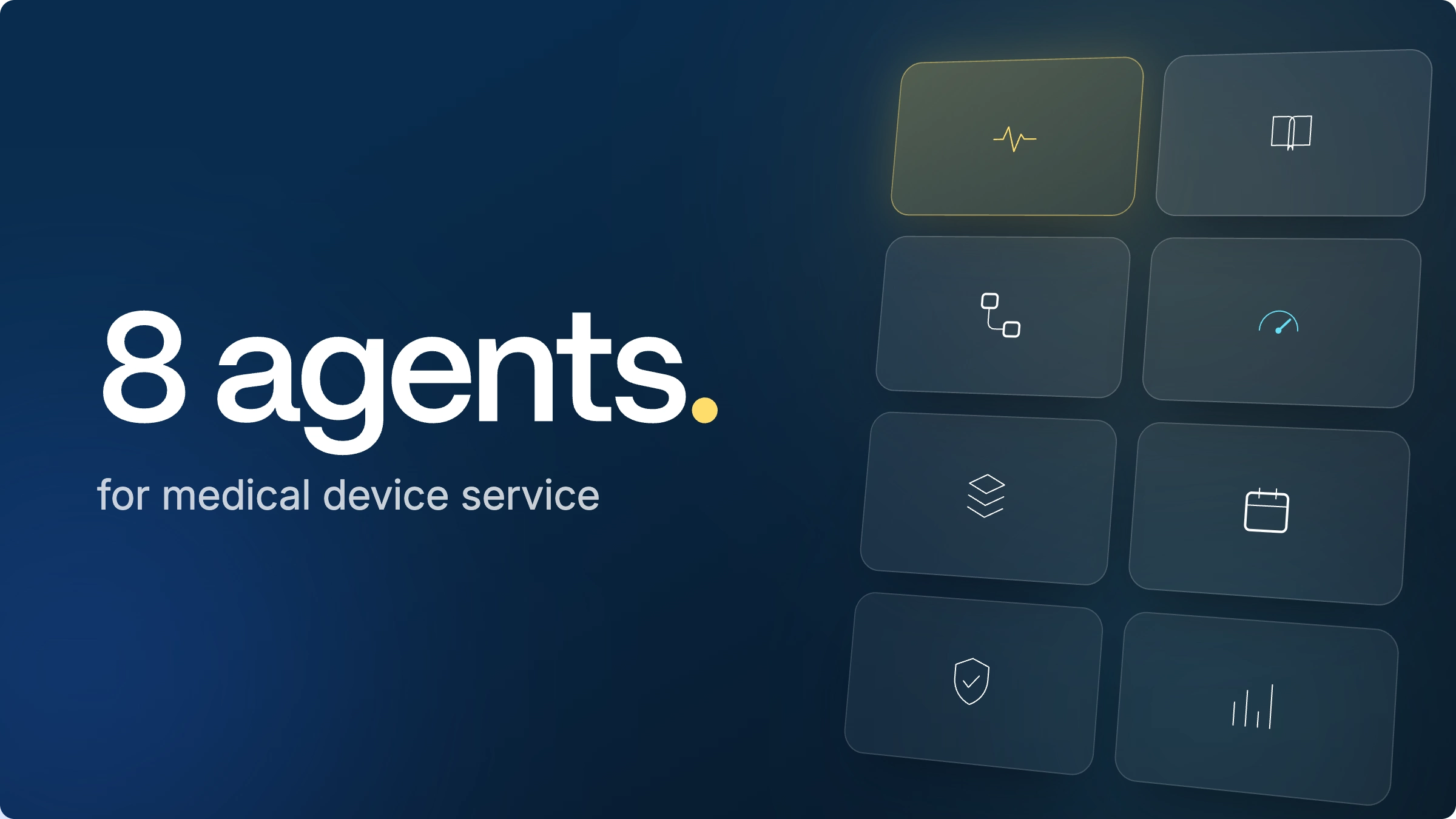
Field service in medical devices is being rebuilt around AI agents as two pressures converge: a shrinking workforce and rising regulatory demands. The U.S. Bureau of Labor Statistics projects about 7,300 annual openings for medical equipment repairers, while the pool of new graduates remains much smaller.
At the same time, the FDA’s Quality Management System Regulation took effect February 2, 2026, aligning device complaint handling with ISO 13485 and adding to the regulatory burden. Together, these pressures make the cost of doing nothing harder to ignore. BCG estimates that AI in field service can drive 15-20% revenue impact, 5-10 percentage points of gross margin, and 20-30% productivity gains.
Most service leaders are past the question of whether to invest. Instead, the focus has shifted to which agents to deploy and in what order. To make that choice clearer, the list below covers seven established agent categories, followed by an eighth that brings them together.
Before getting into the categories, one distinction matters: assisted agents recommend while humans decide; autonomous agents act within defined guardrails. In medical devices, that distinction is critical. The right path is to move from assisted toward autonomous as confidence grows, starting with use cases where the cost of a mistake is lowest. With that framework in place, each category includes a worked example and a clear view of the vendors in the space.
1. Troubleshooting and diagnostic agents
What they do: Diagnostic agents guide a technician to the root cause of a fault and the fix that has already worked, drawing on case history, service logs, and device telemetry. Think turn-by-turn guidance, the way a navigation app routes you around traffic instead of handing you a map.
Why it matters in medical devices: A misdiagnosis on a life-critical device does not stay a productivity problem for long. It can turn into an adverse event and a reporting obligation. Accuracy and traceability carry more weight here than raw speed.
Example (assisted): A technician working an infusion-pump fault gets an agent that reads the device logs, ranks the three most likely causes by how often each fix has actually resolved that error before, and surfaces the validated repair steps for the top one. The technician reviews and confirms before touching the pump.
What to look for: Guidance grounded in fixes your team has performed, from a system that can show its reasoning so it holds up in an audit. Ask any vendor for its error rate in complex service work.
Vendors to know: Aquant, Salesforce Agentforce, ServiceNow AI Agents, TeamViewer, SightCall (remote visual support), Coveo (search)
In practice: TransLogic, the Swisslog Healthcare pneumatic-tube business, reported that resolution time on complex issues dropped from three hours to three seconds at 96 percent accuracy after adopting diagnostic intelligence.
2. Knowledge-capture and onboarding agents
What they do: These agents capture how expert technicians resolve problems, standardize it into reusable guidance, and shorten the time a new hire needs to reach competency.
Why it matters in medical devices: When your best sterile-processing tech retires after twenty years, the expertise walking out the door is worth more than the headcount replacing it. Thousands of biomedical technician roles open each year, and a large share of the current workforce is close to retirement.
Example (autonomous): A senior engineer closes a novel repair on an endoscope reprocessor. Overnight, a knowledge agent turns those case notes into a reusable resolution path, files it in the guidance library, and flags it for a single quality review before it goes live to the rest of the team.
What to look for: A system that learns from every closed case on its own, so knowledge compounds instead of aging in a static article library.
Vendors to know: Glean, ServiceNow Knowledge Management, Salesforce Knowledge, Coveo, Guru
3. Workflow and process agents
What they do: Workflow agents run the operational engine of service: dynamic dispatch, real-time rescheduling, job prioritization, work-order management, and parts allocation.
Why it matters in medical devices: Uptime SLAs on lifesaving equipment leave no slack. One unplanned imaging outage can cost a hospital tens of thousands of dollars over a couple of days, and a technician who shows up without the right part has just guaranteed a second visit.
Example (autonomous): A morning appointment cancels. The dispatch agent rebalances the day across three field engineers by skill, location, and the parts already on each van, reassigns the work, and messages each tech with the updated route. No dispatcher touches it unless the agent hits a constraint it was told to escalate.
What to look for: Deep integration with the field service management system you already run, so the agent acts on live schedule and inventory data rather than a stale copy.
Vendors to know: Platform-native agents in Salesforce Field Service, ServiceNow Field Service Management, Nuvolo (healthcare CMMS on ServiceNow), IFS, SAP Field Service Management, Microsoft Dynamics 365 Field Service, PTC ServiceMax, Timefold
In practice: Terumo BCT, which services apheresis and blood-component systems, reported resolving 13 percent more work orders without a part and cutting part cost per escalation by 24 percent once its service decisions got sharper, for roughly 3x first-year ROI.
4. Predictive-maintenance agents
What they do: Predictive agents forecast failure and prompt maintenance before a breakdown, using sensor data, telemetry, or usage and case patterns.
Why it matters in medical devices: HTM is moving from calendar-based preventive maintenance to condition-based predictive maintenance, a shift now standardized under ANSI/AAMI EQ103 and alternative equipment maintenance programs.
Example (assisted): A predictive agent sees a CT tube trending toward failure and recommends a tube swap inside the next week, with the part identified and the projected downtime attached. A planner still owns the call on when to book the room, because scheduling around patient care is a human decision.
What to look for: Coverage that matches your fleet. Most predictive platforms assume connected assets and a steady sensor feed, so the harder question is whether the tool can predict failure on non-connected equipment from usage and case history.
Vendors to know: GE HealthCare (OnWatch Predict, Tube Watch), Augury, Uptake, C3.ai, Siemens Senseye, IBM Maximo Predict, PTC ThingWorx, Fiix
In practice: GE HealthCare states that Tube Watch can predict a CT tube failure at least 72 hours before it occurs.
5. Customer-experience agents
What they do: These agents handle triage, self-service deflection, and proactive outreach across contact-center channels.
Why it matters in medical devices: Hospital customers and clinicians increasingly want to self-serve. But a deflection that closes a safety-relevant issue with the wrong answer is worse than no deflection at all, so the accuracy bar here sits higher than it does in retail or consumer software.
Example (autonomous): A biomed coordinator submits a routine consumable reorder through the customer portal at 11 p.m. The agent confirms the order against the service contract, places it, and sends a confirmation, all without a human. Anything touching device function or a possible complaint gets routed to a person instead.
What to look for: A clear line between what the agent can safely close on its own and what it must hand to a human.
Vendors to know: Decagon, Sierra, Ada, Cresta, Zendesk AI, Intercom Fin
In practice: Ciena, in a comparable complex-service setting, reported a 14-percentage-point lift in customer satisfaction with 46 percent faster resolutions and a 50 percent increase in deflection.
6. Compliance agents
What they do: Compliance agents monitor deviations, manage CAPA, audit service interactions, and enforce policy at the point of decision.
Why it matters in medical devices: With QMSR now in effect and 21 CFR Part 11 governing electronic records, every service decision has to be traceable. A tool that cannot show its work is a liability the day an auditor arrives.
Example (assisted): A compliance agent reviews every closed service interaction against complaint-handling policy, not the 2 percent a human team could sample by hand. When it spots language that looks like a reportable event, it flags the case to quality and drafts the complaint record. A human decides whether it escalates.
What to look for: This is a distinct category from resolution, served by electronic quality management systems. The question to ask your service AI is whether its resolution decisions leave behind a clean, auditable record these systems can consume.
Vendors to know: Greenlight Guru, MasterControl, Veeva Vault QMS, ComplianceQuest, Qualio, ETQ
7. Regulatory and post-market surveillance agents
What they do: These agents aggregate field-service and complaint data, surface adverse-event and safety signals, and assemble regulatory reports such as MDRs and PSURs.
Why it matters in medical devices: EU MDR mandates structured, routine post-market surveillance, while the FDA runs a mostly event-driven model. Pulling that data together by hand, across systems and jurisdictions, is slow and prone to error.
Example (assisted): A surveillance agent notices the same intermittent fault clustering across three regions over six weeks, connects it to a common component, and assembles a draft signal summary for the next periodic safety report. The regulatory team reviews the evidence and decides what gets filed. A human stays in the loop here without exception.
What to look for: Signal detection that starts from real field evidence rather than a manual data pull. The point most teams miss is that service-resolution data is itself a primary surveillance signal, since every recurring field failure is early evidence of a post-market issue.
Vendors to know: Veeva Vault Product Surveillance, Greenlight Guru, MasterControl, Rimsys, Celegence
8. Service Decision Intelligence, the category that consumes the other seven
This is the category most buyers have not named yet, and the one the previous seven are converging on.
What it is: Service Decision Intelligence turns fragmented service data into accurate, auditable resolution decisions across every channel and system. It does not live inside any one of the seven categories above. It spans them. Diagnostics, knowledge, prediction, and deflection stop being seven separate tools passing tickets between each other and become one decision layer that sits on top of the CRM, FSM, and eQMS systems you already run.
Why it is emerging now: The first seven categories were built as point solutions, each solving one slice of service. That held up while AI assisted a human at a single step. It strains as agents start reasoning across steps, because a diagnosis is only as good as the knowledge behind it, a deflection is only safe if the resolution behind it is right, and a prediction is only useful if it arrives with the fix attached. Gartner projects that by 2029, agentic AI will autonomously resolve 80 percent of common customer service issues without human intervention. Getting to that level of autonomy takes a layer that reasons across the whole service picture, not seven tools handing work back and forth.
Why it matters in medical devices specifically: Autonomy raises the stakes. An agent that acts on its own in a regulated, patient-safety environment has to be deterministic and auditable, and it has to keep a human in the loop on any decision with a safety or reporting consequence. That is a higher bar than a consumer-support agent was ever built to clear, which is why Service Decision Intelligence in this field is measured by accuracy and traceability, not deflection rate.
Example (assisted moving toward autonomous): A hospital reports intermittent errors on a blood-processing system. The decision layer pulls the device logs, reads the error against every prior case on that model, confirms the fix that resolved it last time, checks the part against van stock, and hands the technician a validated resolution path before dispatch. For the highest-frequency, lowest-risk faults, it closes the loop on its own. For anything with a safety dimension, it stops and asks for a human.
What to look for: A layer that reads across your existing stack instead of replacing it. Guidance that is deterministic and grounded in fixes your team has performed. A resolution record clean enough for QMSR and MDR. And a governance model that draws a hard line at autonomous action on safety-relevant decisions.
Vendors to know: Defining the category: Neuron7
Neuron7.ai runs as a resolution intelligence layer on top of Salesforce, ServiceNow, SAP, and Microsoft rather than replacing them, builds a Service Decision Graph from your actual case history, and reports 90 percent or higher resolution accuracy in complex service environments. Neuron7 holds a strategic investment from ServiceNow Ventures and was a launch partner on Salesforce AgentExchange.
If you have been evaluating the first seven categories one tool at a time, this is the reframe worth making. Keep the FSM and the eQMS, and add the decision layer that makes diagnostics, knowledge, prediction, and deflection accurate enough to trust in a regulated setting.
Where to start
Sequence your investment by error cost.
- Begin with diagnostic and knowledge agents, where the value shows up fast and the risk is contained.
- Add workflow and customer-experience agents once your data is clean and connected.
- Extend to predictive, compliance, and post-market surveillance as autonomy and organizational trust mature.
- Budget for change management to take the larger share of the work, since BCG finds roughly 70 percent of the value in a service AI transformation comes from people and process, not code. (One rule overrides the timeline.)
Lastly, never let an autonomous agent make a patient-safety or regulatory-reporting decision without deterministic guardrails and human sign-off. That is the line between Service Decision Intelligence built for medical devices and general-purpose AI with a healthcare label on it.
Explore how Neuron7 combines Service Decision Intelligence with deterministic guardrails and human oversight to help teams resolve complex service issues with greater speed, consistency, and confidence. Request a demo to see it in action.
Related articles



Frequently asked questions
What makes Neuron7 different from other AI tools for service?
Neuron7 differs from other AI tools for service by building a Service Expertise Graph from actual case history rather than searching documents and surfacing suggestions. Resolution guidance is deterministic and grounded in fixes your team has already performed. Neuron7 also predicts failures before they happen and improves with every case closed.
Does Neuron7 replace our existing CRM or ticketing system?
No. Neuron7 does not replace existing CRM or ticketing systems like Salesforce, ServiceNow, or SAP. Instead, it operates as a resolution intelligence layer on top of those systems, adding service expertise and resolution intelligence that those platforms do not natively provide.
How long does deployment take?
Neuron7 deployment typically takes weeks, not months. Most customers are running pilots within weeks of kickoff, starting with the highest-volume product lines and failure patterns before expanding across the installed base.
How does Neuron7 connect to our existing systems?
Neuron7 connects to existing systems through direct integrations with Salesforce, ServiceNow, SAP, Microsoft, and most major CRM and FSM platforms. Pre-built connectors require no custom development and no IT project. Technicians and agents continue working in the tools they already use, with Neuron7 surfacing guidance in their existing workflow.
What kind of service organizations use Neuron7?
Neuron7 is purpose-built for Fortune 1000 enterprises that manage complex technical equipment at scale. This includes medical devices, high-tech manufacturing, industrial systems, payment technology, and telecom organizations. Most customers have 1,000 or more service technicians operating across multiple regions or product lines.
Join the era of agentic service
.png)