
TSW 2026 Recap: What Agentic AI in Support Really Requires

Every AI journey starts where you are
AI in service is moving fast, and it’s easy to feel like you need to leap straight to the end. The service organizations seeing real value are taking it in stages, building on what they already have.
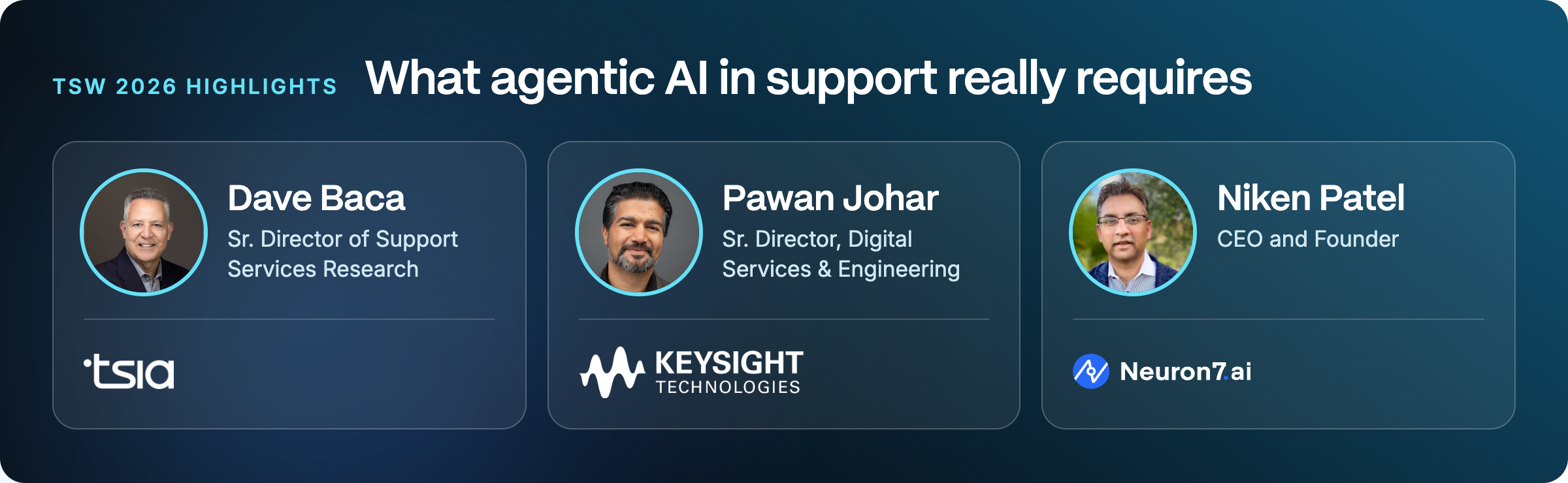
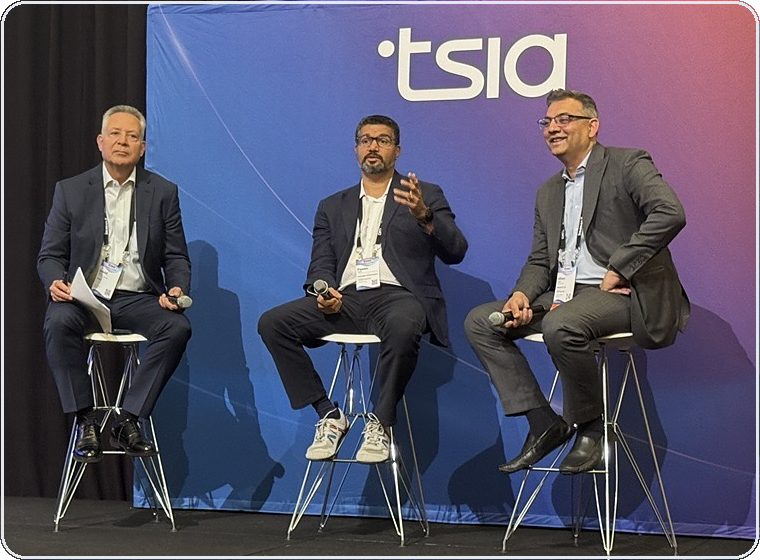
At TSIA’s Technology & Services World in Las Vegas, Pawan Johar, Sr. Director, Digital Services & Engineering at Keysight Technologies, joined Dave Baca, Sr. Director of Support Services Research at TSIA, and Neuron7 CEO Niken Patel to discuss what agentic AI in support really requires. The short answer is more than document retrieval and knowledge base cleanup, and every step along the way delivers value of its own.
Dave’s research shows that most support organizations are still early on the path to full autonomy, and that the gap is operational, not technical. That makes it solvable, and it shows where to focus first.
Know where your data stands
Every service leader knows AI is only as good as the data. The harder question is what to do about it. Start with what you’re trying to achieve and work backward, because guided resolutions and failure predictions need different data. Then grade readiness product line by product line, with clear reasons behind each grade. A low grade isn’t a dead end. It shows what work is required and which product lines are ready now.
Pawan was clear that waiting for perfect data is its own risk, and that the fear of bad data stalls more AI efforts than the data itself.
“Don’t let the data scare you from getting started. Sometimes people have a fear or a mistrust of AI because they think, ‘it’ll hallucinate because our data is so bad.’”
Keysight’s instruments stay in the field for decades, and that history already shows which model families fail, when, and why. Cleaning data and putting it to work can happen in parallel.
Capture what your data is missing
Keysight handles roughly a quarter million repair and calibration events and 100,000 technical support cases a year, across products that span decades. Experienced technicians are retiring, and new hires can’t realistically study a 200-page service manual for every product. Much of the knowledge they need lives with experienced people and in work order data, not in the manuals.
For Pawan, the goal is turning all of that into something newer employees can act on, so senior technicians aren’t needed on every job.
“Can we get to a place where you can synthesize the knowledge that lives across your transactional data set into something qualitative that your newer employees can service without the need for senior technicians to always be looking over the shoulder.”
Pulling experts off the job to document what they know isn’t realistic. That’s why capturing expertise from the work itself, as Neuron7 does with Ambient7, is becoming part of the readiness conversation.
Move from reactive to predictive
Most install bases are still largely unconnected, and Keysight is no exception. Pawan described prediction as a journey Keysight is actively on, and one that doesn’t require connectivity to begin. Modeling decades of service history shows when instruments in a given model family are likely to need attention, whether that’s faster calibration or board-level work, before it becomes a problem.
The goal is to know what’s wrong before an instrument reaches the service center. Then the right part is already waiting, instead of several parts pulled to cover every possibility, and downtime shrinks from weeks to days.
Automate the work that repeats
With that foundation in place, autonomy becomes a practical next step rather than a leap. Once Ciena’s support team trusted the AI’s answers, it extended them to customer self-service.
Pawan’s advice was to “look at the things that are very mundane, repeatable, manual things where people are pushing buttons in the same way every single day,” and start there. Dave added that the biggest payoff comes from looking at a process end to end, then deciding where automation and people each belong. Quick wins build momentum, and redesigning the full process is where they compound.
Start where you are
The path to agentic AI in support runs through data readiness, captured expertise, and prediction, and each stage pays off on its own. You don't need to finish the journey to start seeing results. You just need to know where you stand and take the next step. To see how Neuron7 helps service teams find where to start with AI, get a demo now.
Read next: What service leaders shared at the Service Council Executive Symposium
Related articles



Frequently asked questions
What makes Neuron7 different from other AI tools for service?
Neuron7 differs from other AI tools for service by building a Service Expertise Graph from actual case history rather than searching documents and surfacing suggestions. Resolution guidance is deterministic and grounded in fixes your team has already performed. Neuron7 also predicts failures before they happen and improves with every case closed.
Does Neuron7 replace our existing CRM or ticketing system?
No. Neuron7 does not replace existing CRM or ticketing systems like Salesforce, ServiceNow, or SAP. Instead, it operates as a resolution intelligence layer on top of those systems, adding service expertise and resolution intelligence that those platforms do not natively provide.
How long does deployment take?
Neuron7 deployment typically takes weeks, not months. Most customers are running pilots within weeks of kickoff, starting with the highest-volume product lines and failure patterns before expanding across the installed base.
How does Neuron7 connect to our existing systems?
Neuron7 connects to existing systems through direct integrations with Salesforce, ServiceNow, SAP, Microsoft, and most major CRM and FSM platforms. Pre-built connectors require no custom development and no IT project. Technicians and agents continue working in the tools they already use, with Neuron7 surfacing guidance in their existing workflow.
What kind of service organizations use Neuron7?
Neuron7 is purpose-built for Fortune 1000 enterprises that manage complex technical equipment at scale. This includes medical devices, high-tech manufacturing, industrial systems, payment technology, and telecom organizations. Most customers have 1,000 or more service technicians operating across multiple regions or product lines.
Join the era of agentic service
