
Where does your expert knowledge live?

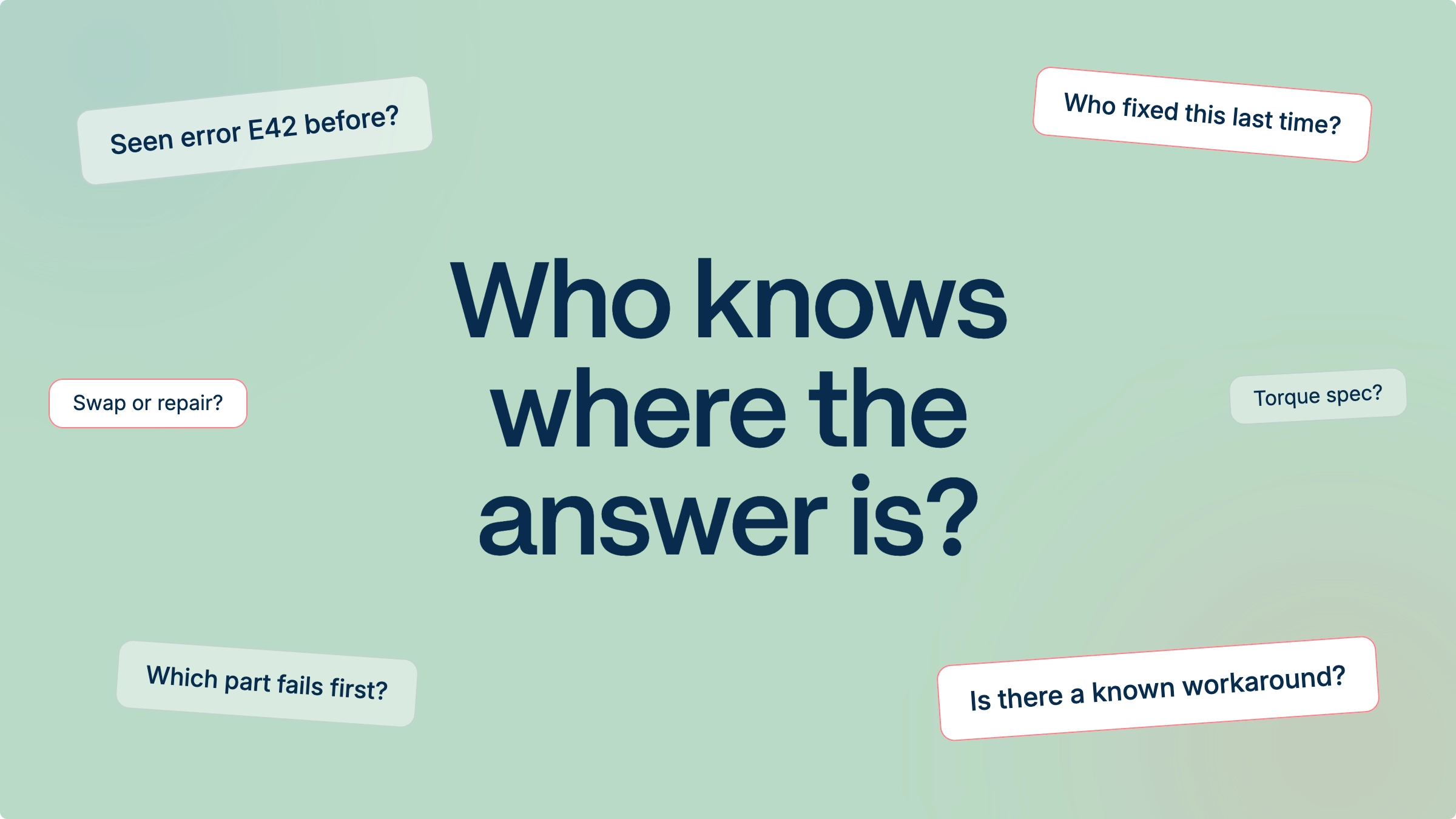
200 service leaders couldn’t say where expert knowledge lives
At Field Service Next Europe, I asked a room of 200 service leaders a question: where does expert knowledge live in your organization? No one had an answer.
I keep coming back to that. These are people who run complex service operations, and their best technicians fix problems you won’t find in any manual. They know the expertise is somewhere in within the organization. But no one in the room could pinpoint where.
Everyone’s AI runs on the same four sources
Most service teams point their AI at a knowledge base, manuals, case history, and a search layer on top. That’s the standard setup, and it explains the silence in the room. The knowledge base got written once and gets updated when someone remembers. Manuals tell you how the product should work and go quiet on how it breaks in the field. Case history shows what someone typed into the ticket, and rarely what fixed it. Search will happily hand you twelve documents and leave the choosing to you.
If you think about it, every vendor aims its AI at those same four sources, so every AI program will give roughly the same answers. The difference is that the judgment behind how an issue was resolved on a specific machine actually sits in a technician’s head, and it isn’t always captured in standard AI tools.
The experts are retiring on schedule
And the knowledge gap widens every year. About 45% of field service technicians are 50 years olor older. A new tech needs 12 to 18 months to reach full proficiency, and less than 10% of what your most tenured technician's know ever makes it into a manual. Every retirement takes more and more knowledge with it, and there’s not much service organizations are doing to stop it.
The timing is rough. For years service got judged on cost: first-time fix rates, repair times, cost per case. These days, boards want margin and revenue, so think proactive maintenance, warranty savings, fewer truck rolls, and down the road outcome-based contracts. But you can’t deliver more with less if the expertise needed to get there is walking out the door.
Why AI use cases stall
Gartner expects more than 70% of AI use cases to miss the value they were funded for and blames weak financial and change management discipline. In service, we see something else: the data underneath can’t back up the decisions the AI is asked to make. The demos wow everyone, and a year later they still aren't in production.
Gartner’s 2026 service survey shows where teams are putting their effort. Most of it goes to summarization, routing, tagging, and search. Those come bundled in a platform and cost little to run, and the payoff is mostly time saved, which only counts once someone turns it into something the business can measure. The use cases leaders rank highest for value, like root cause analysis and next best action, have barely been adopted. Expert knowledge capture sits in that same corner. Gartner scored perceived value, not dollars, but the gap is big. Root cause and next best action both need expert knowledge underneath, which takes me back to my question in that room. Capture comes first, since the rest depend on it.
Start with the fixes your experts already made
Your experts have been documenting their judgment for years, just not anywhere your AI looks. Every case a senior technician closed has the reasoning in it: which symptoms pointed to which root cause on which product. Neuron7 reads those closed cases and pulls that reasoning out, and experts don’t have to document anything differently.
Subject matter experts check each new pattern before it goes live. Once they sign off, it becomes a guided pathway in the Service Decision Graph, so a new hire or a mid-level tech can work the way your best expert does. Every finished job feeds back in, so the graph gets better with each fix.
Ambient7, our wearables product, takes this onto the job site. It records what experts see and do while they work, so the stuff that never made it into a case note gets passed on instead of walking out the door.
Try this next
Name the five experts you can’t afford to lose. Then ask where each one’s fix would live the day they walk out. If the answer is a knowledge base article, check when someone last updated it. If the answer is that person’s head, you’ve found the foundation problem.
For a broader look at what complex service AI needs underneath it, read The Service Foundation Problem.
Related articles




Join the era of agentic service
