
A Conversation with Bill Girzone of NCR Atleos

NCR Atleos is a $4.1B global enterprise that helps banks and retailers deliver best-in-class self-service solutions through industry-leading technologies and unmatched global services capabilities.
Bill Girzone, SVP Global Field Services, discusses how NCR Atleos works with Neuron7.ai to reduce call handle times, the importance of time to value, finding a solutions-oriented partner in AI for service, and more.
Q: What challenges lead to AI becoming a priority?
Bill Girzone: This was the beginning grounds of AI for NCR Atleos. These are quintessential services issues: first time resolve, revisits, and massive amounts of attrition in different parts of the world.
So, a lot of onboarding of new folks, which creates issues with scaling training, scaling our tech support. We really needed a solution that didn’t grow with the size of the problem.
Q: What were you looking for in an AI partner?
Bill Girzone: One of the big things was not having a lot of the technology in-house. We really wanted to work with someone who would stay ahead of the technology curve. That was important to us.
Another really big one was for some of the behemoth software companies translating their solutions down to what we specifically need, that almost felt impossible.
What we really needed was a partner that could understand our needs, understand our business, and then tune the products to do what we needed them to. And that’s ultimately what I saw in Neuron7 and that was a big piece of how we started on the path together.
Q: What are some of the takeaways and results you’ve experienced?
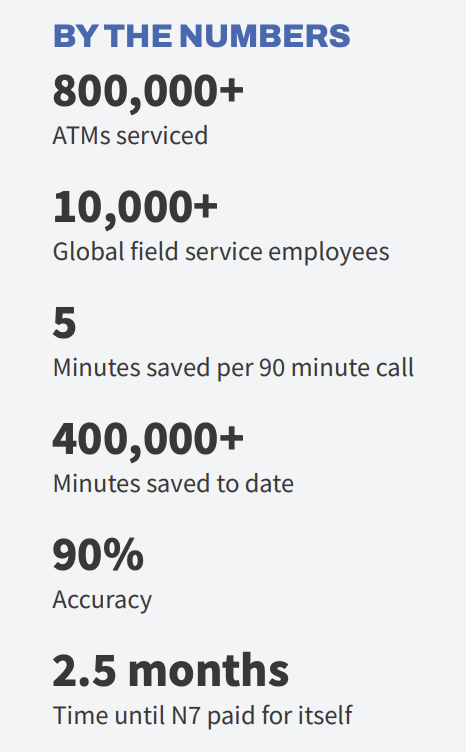
Bill Girzone: First, this wasn’t something we needed to spend 12 or 18 months developing. This was real…I didn’t have to wait. From an operational leader perspective, that’s gold. This isn’t a 2026 type of discussion.
In services, it’s about first-time resolve. That’s one of our most important KPI. So how long does it take to close a field services case? Somewhere on the order of 90 minutes. Every minute matters.
When you take Intelligent Search, we’re averaging around five minutes of savings on a thousand calls a day. That’s 6 or 7% on a 90-minute call. That’s huge. That product paid for itself even in its infancy in about two and a half months.
Q: What are you looking forward to next in the AI journey at NCR Atleos?
Bill Girzone: I think that we’re still at the beginning phases and already experiencing a strong return. Just in the 80,000 uses since it started, at five minutes a piece, that’s 350-400,000 minutes saved.
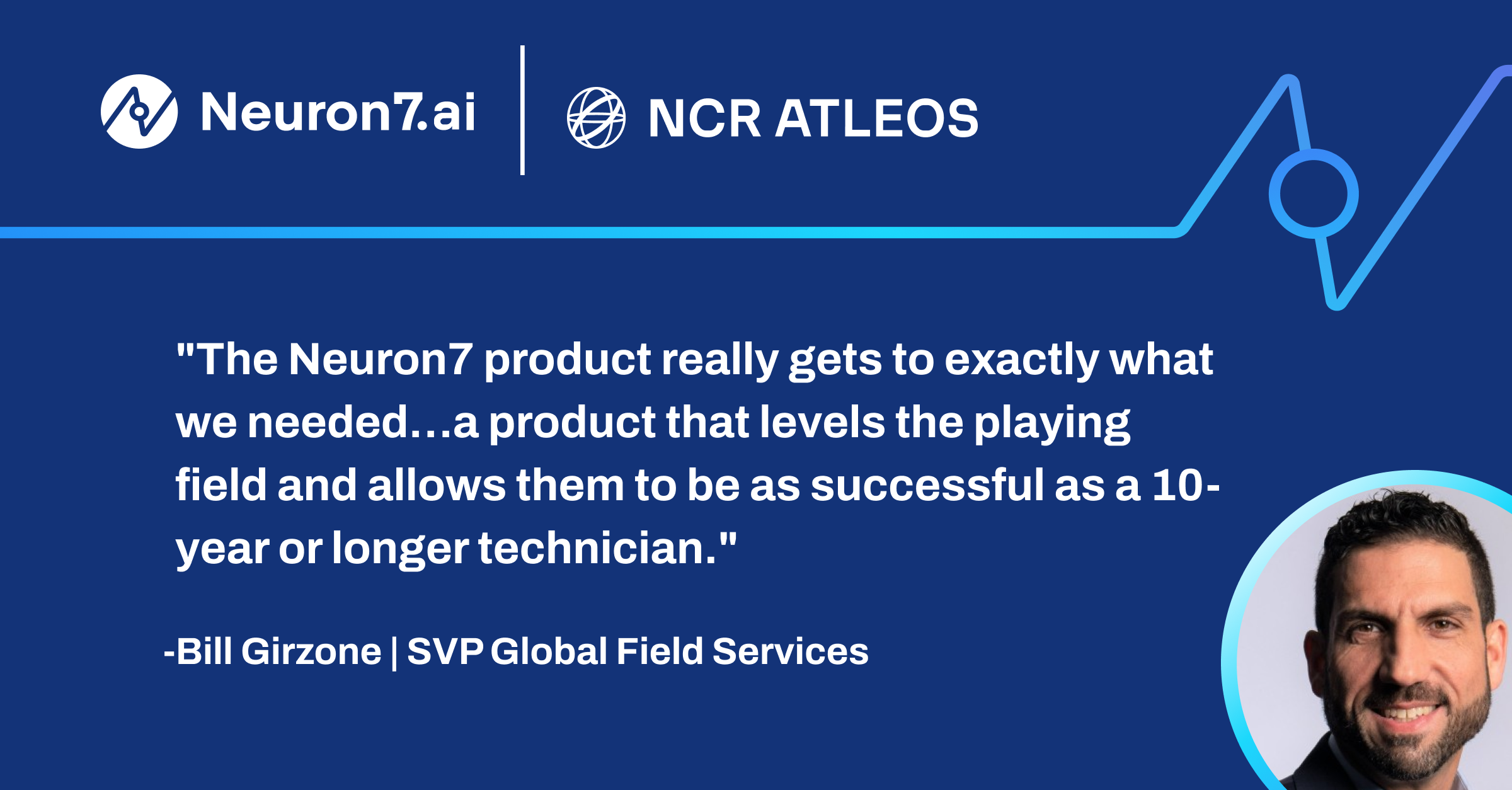
The Neuron7 product really gets to exactly what we needed, which was to get technicians who were newly onboarded…a product that levels the playing field and allows them to be as successful as a 10-year or longer technician. And that’s really what we hope to get with Intelligent Diagnostics.
And one of the unexpected things, as we talked about the future state Neuron7 product lines, those products match where we’re headed. When you think about next likely failure or preventative maintenance on an individual unit, this is the stuff that is ultimately what NCR Atleos needs to change and evolve our service model.
Q: What advice would you give service leaders advocating internally for AI solutions?
Bill Girzone: The biggest thing here is reframing your risk…So, the risk is that you have this massive amount of spend (on revisits) that’s effectively the cost of poor quality or waste. The scrutiny should be there. Not as much on trying something new.
And I think don’t be afraid. That was it for me. It’s the risk of not doing something. The risk is when you have to ramp hundreds and hundreds of new people through extensive training and have them still not be as good as you want them to be. That’s not sustainable. That’s what hurt services. That’s what crunches your margins and hurts your customer sentiment.
And I think what’s interesting about some of the AI solutions is that they don’t scale with the size of the problem. They level that playing field, so to speak.
Related articles



Frequently asked questions
What makes Neuron7 different from other AI tools for service?
Neuron7 differs from other AI tools for service by building a Service Expertise Graph from actual case history rather than searching documents and surfacing suggestions. Resolution guidance is deterministic and grounded in fixes your team has already performed. Neuron7 also predicts failures before they happen and improves with every case closed.
Does Neuron7 replace our existing CRM or ticketing system?
No. Neuron7 does not replace existing CRM or ticketing systems like Salesforce, ServiceNow, or SAP. Instead, it operates as a resolution intelligence layer on top of those systems, adding service expertise and resolution intelligence that those platforms do not natively provide.
How long does deployment take?
Neuron7 deployment typically takes weeks, not months. Most customers are running pilots within weeks of kickoff, starting with the highest-volume product lines and failure patterns before expanding across the installed base.
How does Neuron7 connect to our existing systems?
Neuron7 connects to existing systems through direct integrations with Salesforce, ServiceNow, SAP, Microsoft, and most major CRM and FSM platforms. Pre-built connectors require no custom development and no IT project. Technicians and agents continue working in the tools they already use, with Neuron7 surfacing guidance in their existing workflow.
What kind of service organizations use Neuron7?
Neuron7 is purpose-built for Fortune 1000 enterprises that manage complex technical equipment at scale. This includes medical devices, high-tech manufacturing, industrial systems, payment technology, and telecom organizations. Most customers have 1,000 or more service technicians operating across multiple regions or product lines.
Join the era of agentic service
.png)